

The Bridge Audience
For a long time, race teams sorted themselves into two camps. If you were a club racer or a small program, you ran a dually with an open or enclosed trailer. If you were a serious regional outfit or above, you ran a Class 8 semi with a 53-foot stacker. There was no middle.
That gap got crowded as the equipment got better. Modern enclosed stackers in the 28 to 36-foot range now carry two cars, a workshop, and a sleeping loft. Loaded, they weigh 18,000 to 28,000 pounds. That’s too much for a one-ton pickup to handle responsibly. It’s also nowhere near enough to justify a semi, the CDL driver, the commercial insurance, and the logistical overhead that comes with one.
The medium-duty hauler truck sits exactly in that space. It’s the answer for teams that have outgrown the dually but don’t need (and don’t want) the complications of a Class 8 rig.
What a Medium-Duty Hauler Actually Is
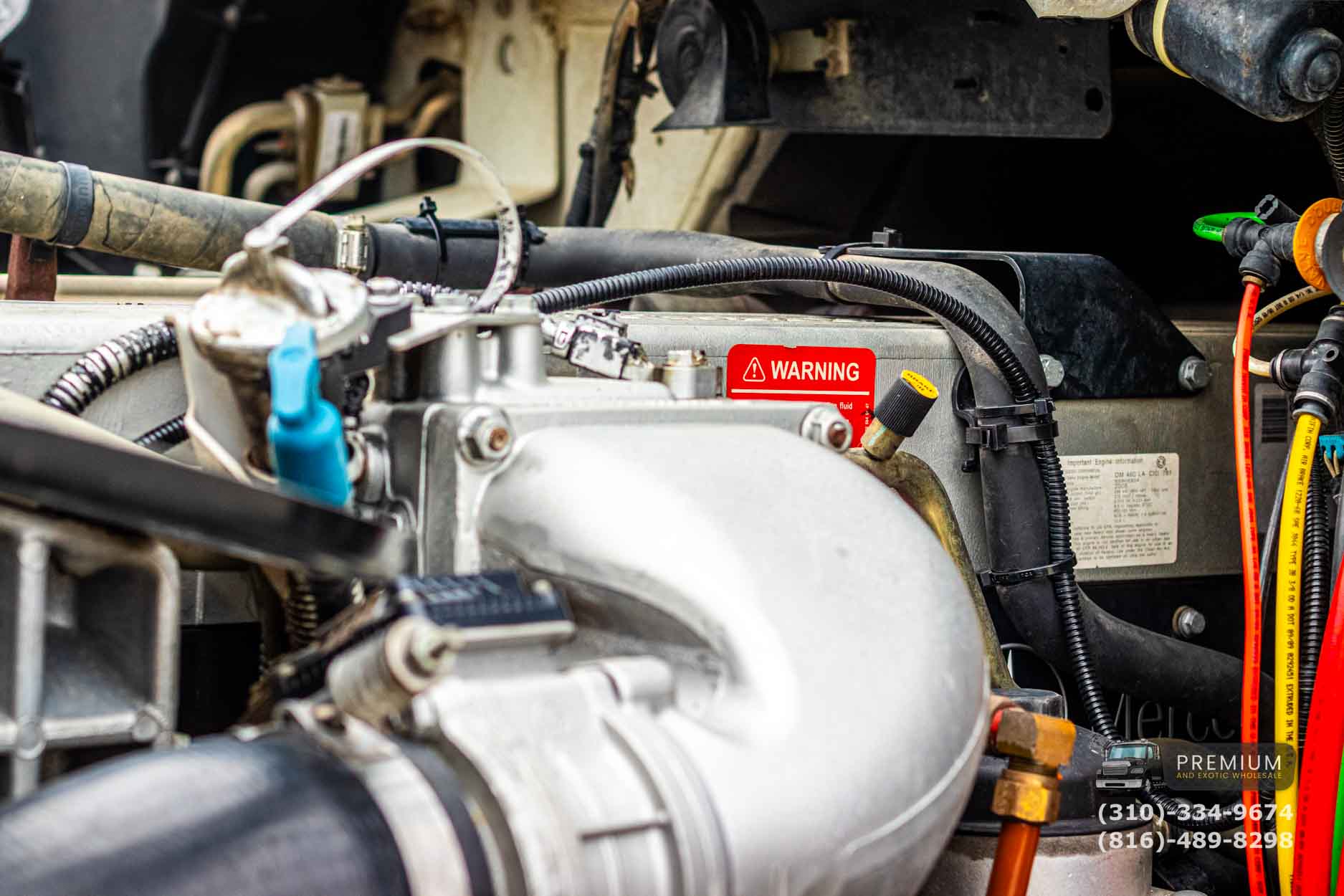
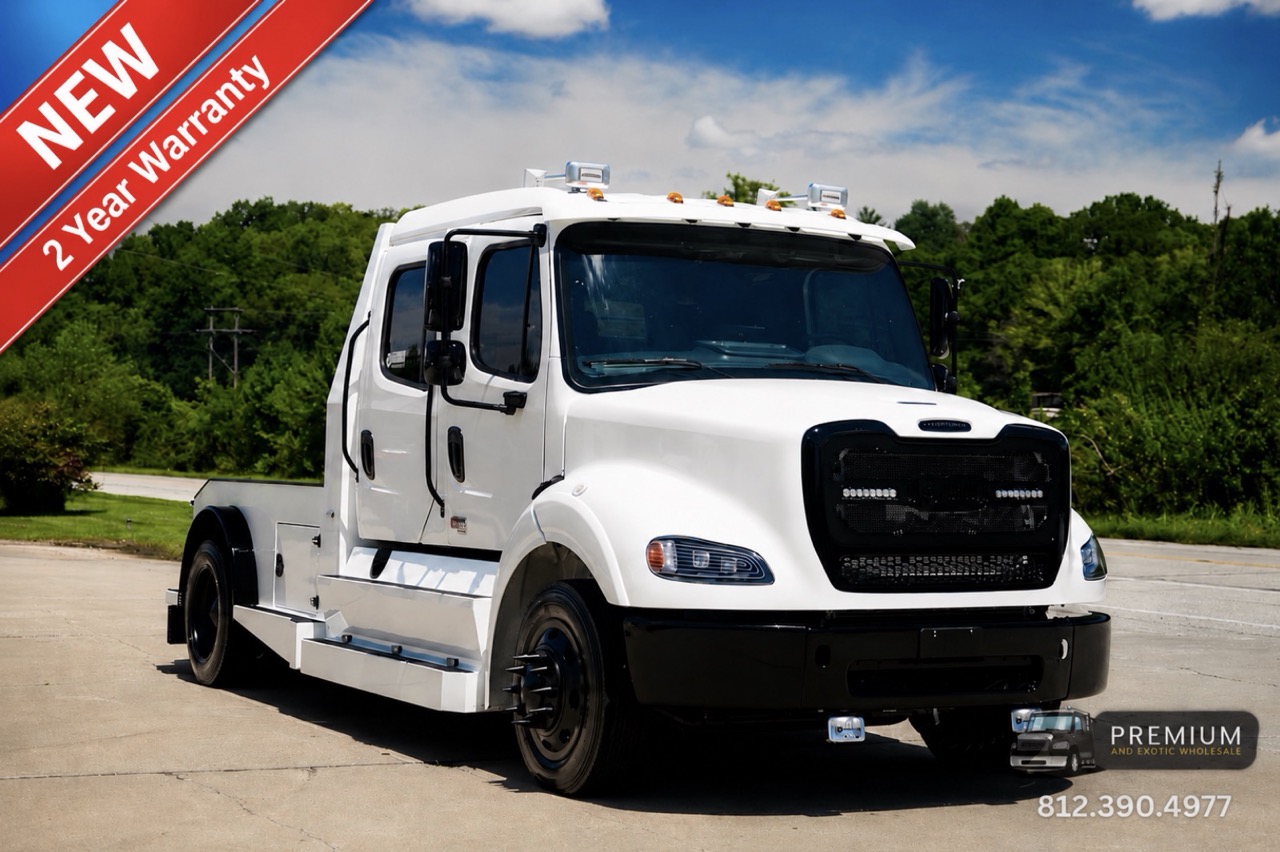
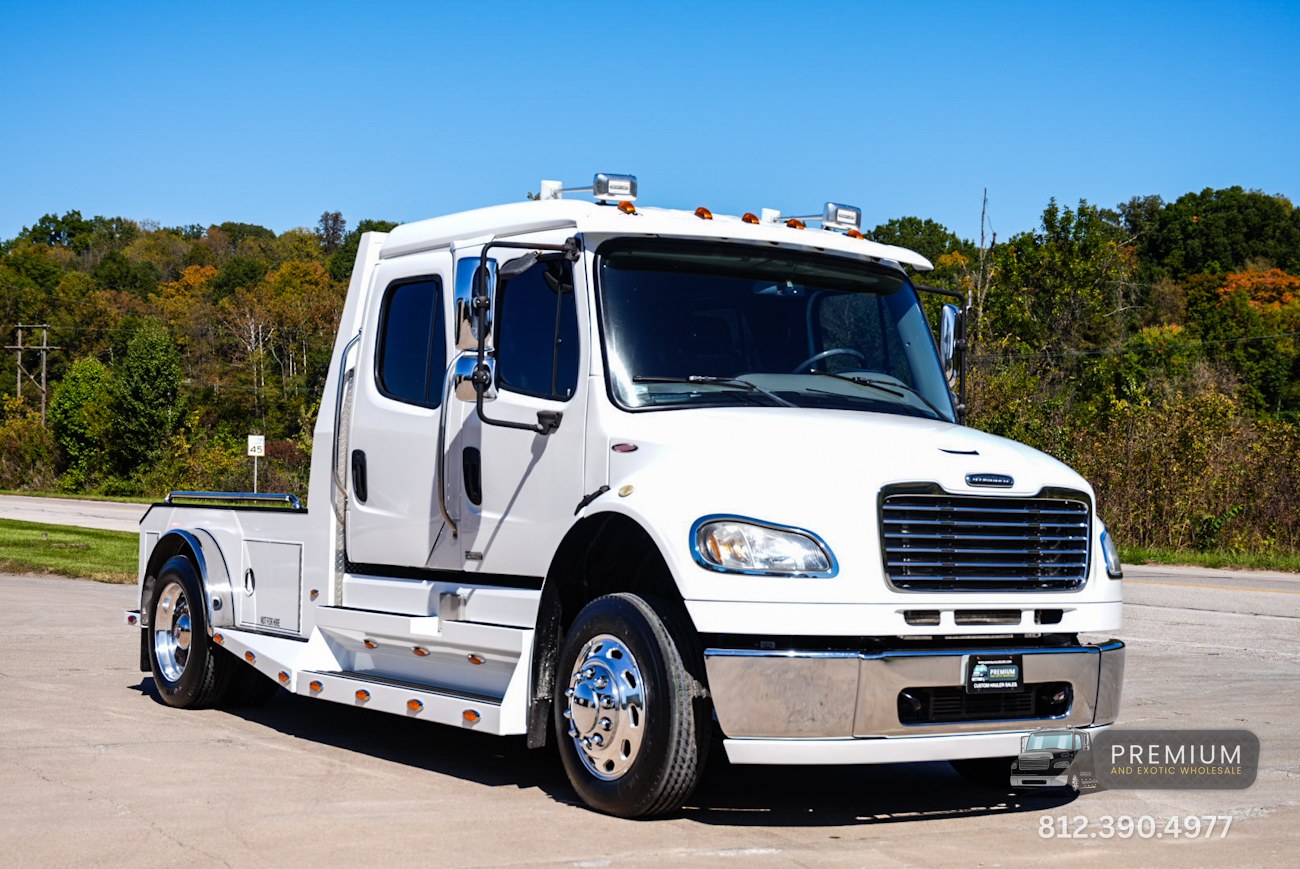
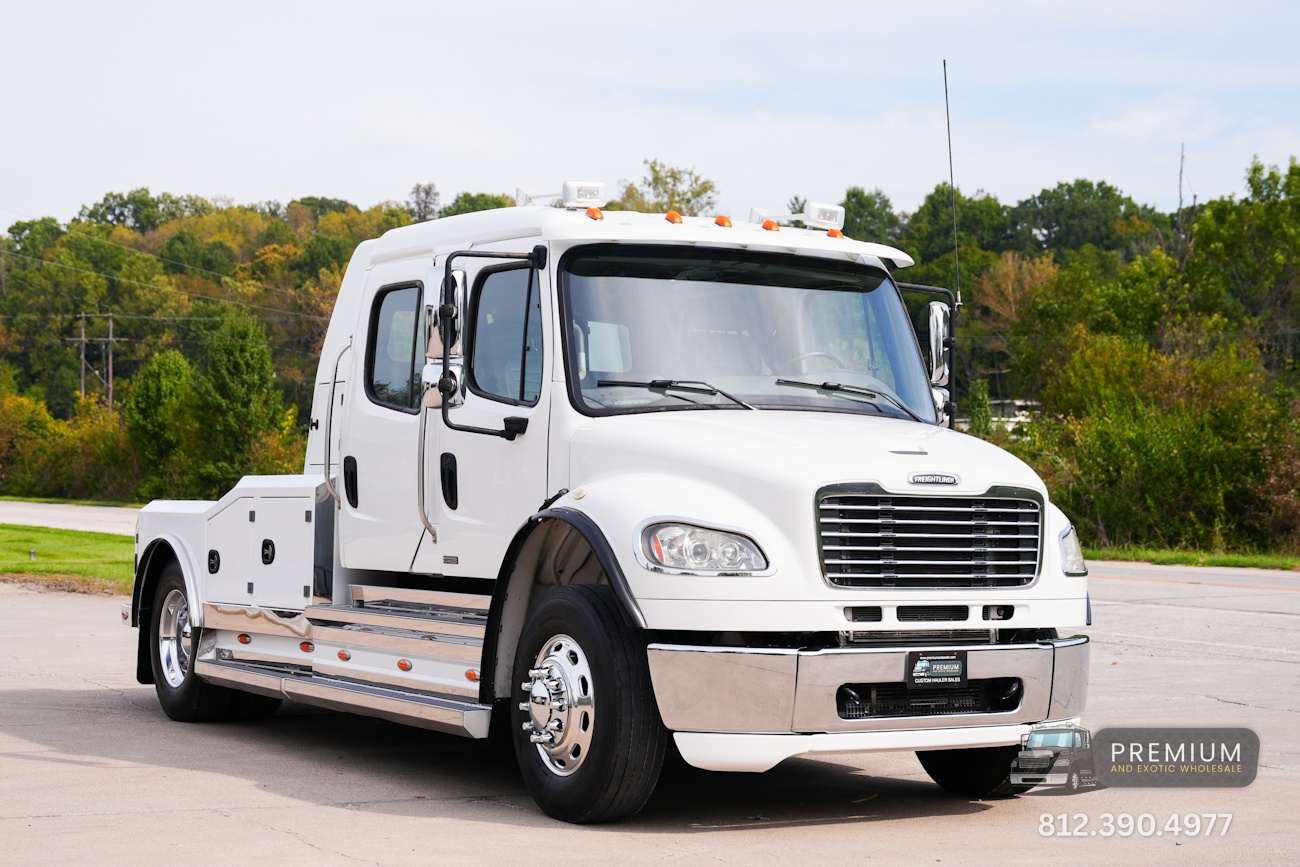
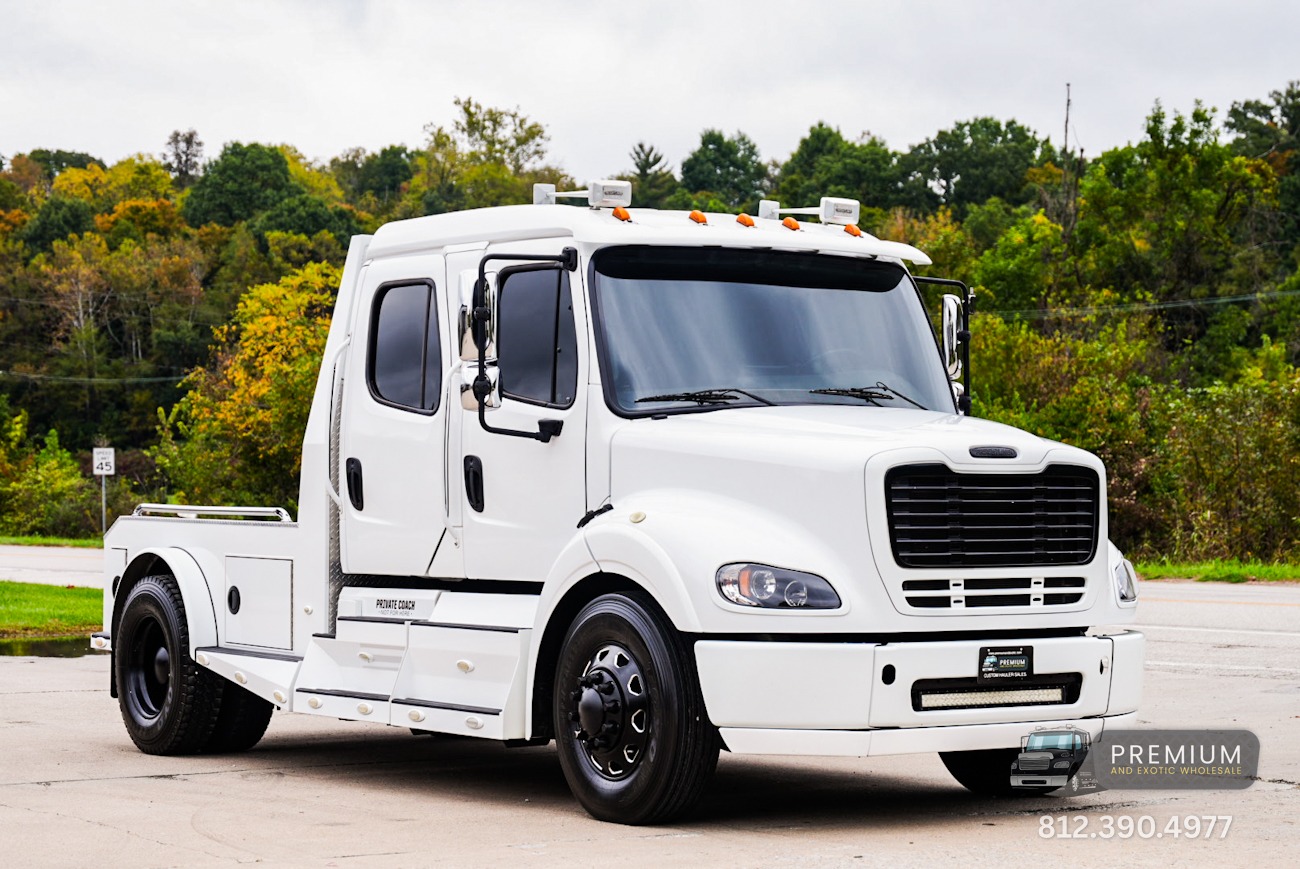
Medium-duty haulers are commercial trucks (Freightliner M2 106, Peterbilt 330/337, Kenworth T270, Laredo conversions on the M2 112) converted for personal and recreational use. They use proven commercial drivetrains: Cummins B6.7 diesel, Allison automatic transmission, air ride suspension. The cabs get upgraded interiors and crew cab conversions. The hitches get matched to whatever the team is pulling.
Configured for racing, a typical hauler will run:
- GVWR of 23,000 to 26,000 lbs (kept under 26,001 to stay out of CDL territory in most states)
- GCWR of 37,000 to 52,000 lbs depending on configuration
- Payload of 8,000 to 14,000 lbs
- Cummins B6.7 producing 260 to 360 hp and 660 to 800 lb-ft depending on the tune. Most Sport Chassis builds run the 260 to 300 hp tunes; the 360 hp tune is a heavier-duty commercial spec not commonly chosen for personal use.
- Allison 2500 or 3000 series 6-speed automatic
- Air brakes or heavy hydraulic discs
- Engine or exhaust brake for sustained downhill control
That’s the platform. Now the case for why teams are landing on it.
The Case Against the Dually
A new F-350 or Ram 3500 dually is a capable truck. The spec sheet says it can tow 35,000+ pounds. The spec sheet is misleading.
Payload is what fails first. A loaded crew cab dually has roughly 4,200 to 5,500 lbs of payload. A loaded 32-foot stacker with two cars puts 4,000 to 5,500 lbs of pin weight on the truck. Add driver, passenger, fuel, tools, coolers, and pit gear in the bed, and you are over payload before you leave the shop.

Over payload means the brakes are working harder than they’re rated to work. The tires are running hotter than they’re rated to run. The rear suspension is fatiguing faster than it’s designed to fatigue. None of this fails on the first trip. It fails on the 50th, somewhere between Charlotte and Sebring, with two race cars and a teammate’s life riding on the rear axle.
Beyond payload, there’s the question of how the truck feels under load. A dually at 90 percent of its rated capacity drives like a dually at 90 percent of its rated capacity. The engine works hard. The transmission shifts more. The brakes fade on long descents. By the time the team gets to the track, the driver has spent the trip managing the rig instead of resting.
The Case Against the Semi
For most teams, the semi solves the wrong problem. Yes, it has the capacity. Yes, it carries everything. But it brings its own catalog of friction.
You need a CDL Class A driver. That’s either a hired wheel or a team member who built that license and is now committed to keeping it current. Either way, your travel logistics revolve around one person.
Commercial insurance for a Class 8 operation runs $8,000 to $15,000+ per year, sometimes higher depending on cargo value and team history. That’s two to four times what a personal-use hauler costs to insure.
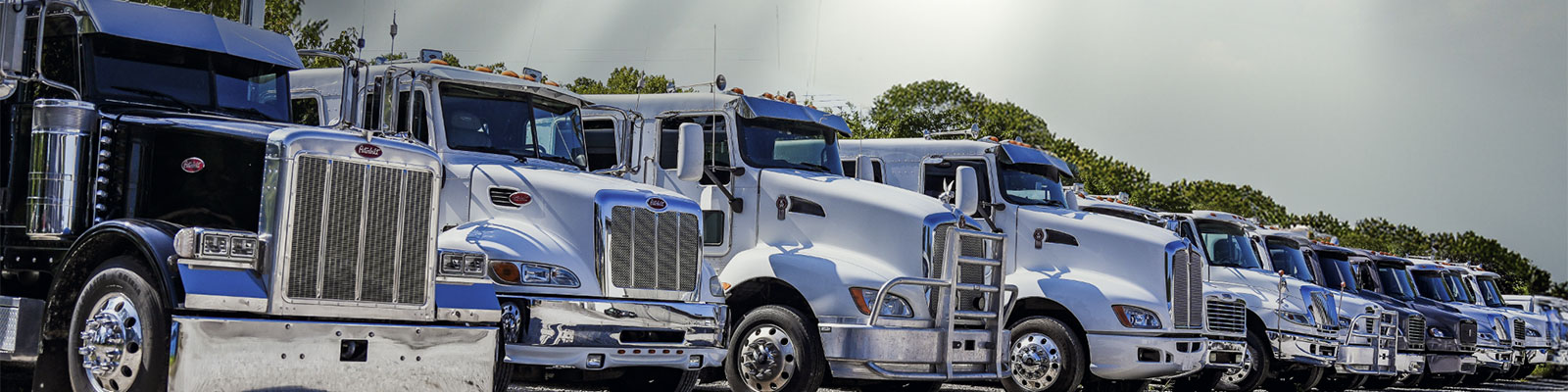
Then there’s the daily reality of moving a 53-foot rig around. Truck stops only. Limited paddock space at smaller tracks. Tight pit areas that were designed for trailer rigs, not full tractor-trailers. Bridges, weight stations, fueling that requires a commercial pump. Drive-throughs are not happening. Hotel parking is a logistical exercise.
For a top-tier IMSA team, the semi is the right tool. For a privateer running a regional GT series, or a club team campaigning two cars at NASA weekends, or a sprint car operation hitting a regional circuit, the semi is a tool that costs more than it returns.
What the Hauler Solves
The medium-duty hauler hits the middle for specific reasons.
Driver access. Any team member with a regular license can drive it. Some configurations with air brakes require an air brake endorsement, which is a written test at the DMV, not a career change. The team’s travel schedule is no longer dictated by who has a CDL.
Real capacity. A loaded 32-foot stacker at 24,000 lbs is comfortable behind a medium-duty hauler with a 50,000-lb GCWR. The truck is at 70 percent of its rating. The brakes have margin. The engine isn’t gasping. The transmission is in its happy range.
Braking that matches the load. Air brakes (or heavy hydraulic discs on smaller configurations) combined with an exhaust brake or engine brake mean the team can descend a real grade with a real load without fading the service brakes. This is not a track-day theoretical. It’s a Friday-night reality for any team racing east of the Rockies or anywhere in the West.
Paddock fit. A medium-duty hauler with a 32-foot stacker takes up the same paddock space as a long-bed dually with a comparable trailer. The team fits in the spots assigned to trailer rigs, not the spots reserved for Class 8. Pit setup is the same. Maneuvering is the same.

Standard fuel and lodging. Diesel pumps at any truck stop. Hotel lots that accommodate large pickups. Restaurants the team can actually park at. The hauler operates in the same world the dually operates in, just with more capability.
A presentable rig. This matters more than racers like to admit. Sponsors and prospective sponsors are watching how teams show up. A clean medium-duty hauler with team graphics and a coordinated stacker projects a professional operation. It’s not about flexing. It’s about looking like a team that respects the sport enough to arrive prepared.
Where the Hauler Doesn’t Win
Honest assessment. The medium-duty hauler is not the answer for every team.
If the program requires more than two cars and a full mobile workshop, the hauler runs out of room before the semi does. Three-car operations, traveling support staff, hospitality units, and the rest of a top-tier professional setup need Class 8 capacity.
If the team is already running a CDL operation and has the driver, the insurance, and the logistics dialed, switching down to medium-duty is a lateral move at best.
And if the trailer is genuinely a 53-foot stacker (not a 32 to 36-foot version), the truck side of the conversation is already settled. That’s a semi.
The hauler wins for the team that is past the dually’s capabilities but doesn’t have a real need for the Class 8 escalation. That’s a large and growing segment of the racing world.
Configurations Teams Are Building
A few patterns show up repeatedly when teams spec out a hauler.
Two-car club racer. Crew cab Sport Chassis or Laredo, flatbed or short utility bed, pulling a 32-foot enclosed stacker. Carries two cars, loft for spares or sleeping, tire racks, generator, full pit kit. Total rig length comparable to a long dually plus 32-foot trailer.
Single-car program with full workshop. Crew cab hauler, utility bed for tooling, pulling a 28-foot enclosed trailer outfitted as a mobile workshop. Welding equipment, fabrication bench, full tool inventory. The truck’s bed and cab hold whatever doesn’t fit in the trailer.
Drag or sprint team. Sometimes a hauler with a flatbed configuration carrying one car on the deck and towing a second car or equipment behind. The truck doubles as the transport for the primary car, which simplifies paddock setup.
In all three patterns, the truck is doing real work and the team is operating in the right weight class for the equipment.
What This Costs
A used medium-duty hauler in good condition runs $70,000 to $140,000 depending on platform, mileage, and conversion quality. A new build typically lands $150,000 to $250,000+. Insurance for personal use runs $3,000 to $6,000 annually in most states.
For a team that’s currently breaking dually transmissions every 80,000 miles, burning brake jobs every 30,000 miles, and replacing tires on a schedule the manufacturer didn’t intend, the math works. For a team weighing a semi against a hauler, the hauler is materially cheaper to run, though the exact gap depends on annual mileage, fuel routes, and whether the team is paying commercial shop rates or has its own mechanic.
The Match That Defines the Team
A serious racing program is not built around a single piece of equipment. It’s built around how the pieces fit together: the car, the trailer, the tow vehicle, the spares, the people. The hauler is the connective tissue. It either makes the operation work or it doesn’t.
For a race program, the hauler is the logistics backbone. It does not just move the car. It is mobile pit space, fuel, spares, hospitality on the bad weekends, and the rolling reputation of the team in the paddock. Get the truck right and the operation gets quieter and more reliable across an entire season.
Premium and Exotic has supplied trucks to professional race operations and to one-car amateur owners, and the team has watched what works at both ends of the budget. Talk to the Bloomington dealership with a real picture of the program: the series, the average travel distance, the trailer length and pin weight, the crew count, the fuel strategy. The right truck reads off that picture quickly.
Schedule a walkthrough through premiumandexotic.com, or call the dealership to start the conversation by phone before traveling.





You must be logged in to post a comment.